|
"Psyche Revived by Cupid's Kiss" (Canova 1787)
|
Saturday Sepember 24, 2011
I wish I had time to write an Ode to Paris. Perhaps on the plane because we are leaving for the airport now... Suffice to say its after 4 am and we have barely slept since we got here. Its just an amazing city. We walked its streets, drank its wine and champagne, sat in the shadow of its tower, walked its museums, bought stuff in its shops, smiled at its citizens, sat on the banks of its river, etc etc etc! My pics will have to do for now... Off to London!
Kev
 |
| These guys look a little disappointed... |
Once upon a time there was a king with three daughters. They were all beautiful, but by far the most beautiful was the youngest, Psyche. She was so beautiful that people began to neglect the worship of Venus, the goddess of love and beauty. Venus was very jealous, and asked her son Cupid (the boy with the arrows) to make Psyche fall in love with a horrible monster. When he saw how beautiful she was, Cupid dropped the arrow meant for her and pricked himself, and fell in love with her.
Despite her great beauty no-one wanted to marry Psyche. Her parents consulted an oracle, and were told that she was destined to marry a monster, and they were to take her to the top of a mountain and leave her there. The west wind took her and wafted her away to a palace, where she was waited on by invisible servants. When night came her new husband visited her, and told her that he would always visit her by night and she must never try to see him.
Although her invisible husband was kind and gentle with her, and the invisible servants attended to her every desire, Psyche grew homesick. She persuaded her husband to allow her sisters to visit her. When they saw how she lived they became very jealous and talked Psyche into peeking at her husband, saying that he was a monster who was fattening her up to be eaten and that her only chance of safety was to kill him. Psyche took a lamp and a knife, but when she saw her beautiful husband, Cupid, she was so surprised she dripped some hot wax onto his shoulder, waking him. He took in the situation at a glance and immediately left Psyche and the magnificent palace she had been living in disappeared in a puff of smoke.
Psyche roamed about looking for her husband, and eventually in desperation approached his mother, Venus.
This winged young man who has just landed on a rock where a girl lies unconscious, is the god Eros – Cupid in Latin – and can be recognized by his wings and his quiver filled with arrows. The girl’s name is Psych. Cupid’s mother Venus, goddess of Beauty, demanded that Psyche bring back a flask from the Underworld, strictly forbidding her to open it.
But Psyche’s curiosity got the better of her; and no sooner had she had breathed in the terrible fumes than she fell into a deep, deathlike sleep. Seeing her lying motionless, Cupid rushed to her and touched her gently with the tip of his arrow, to make sure she was not dead. This is the moment caught by the sculptor: Cupid lifts his beloved Psyche in a tender embrace, his face close to hers. Psyche lets herself sink slowly backwards, languorously taking her lover’s head between her hands.
At the close of the tale the gods decide in council to grant Cupid Psyche’s hand in marriage, according her immortality and making her the goddess of the Soul.

"
Psyche Revived by Cupid's Kiss" (Canova 1787)
The "Dying Slave" was carved by Michelangelo between 1513 and 1516. The man's left wrist is strapped to the back of the neck, and there is a band around his chest. A monkey, only partially carved, grasps his left shin, representing either art as mere "aping" or suggesting earthly passions. In 1976 the art historian Richard Fly wrote that it "suggests that moment when life capitulates before the relentless force of dead matter".
"La Chaste Suzanne" By Chasseriau
Francesca et Paolo (Ary Scheffer)
Paolo & Francesca were historical contemporaries of Dante. Francesca's father, Guido da Polenta, lord of Ravenna had waged a long war with Malatesta, lord of Rimini. Finally peace was made through intermediaries, and to make it more firm, they decided to cement it with a marriage. Guido would give his beautiful young daughter Francesca in marriage to Gianciotto, eldest son of Malatesta. Though Gianciotto was very capable and expected to become ruler when his father died, he was ugly and deformed. Guido's friends informed him that if Francesca sees Gianciotto before the marriage, she would never go through with it. So they sent Gianciotto's younger brother Paolo to Ravenna with a full mandate to marry Francesca in Gianciotto's name. Paolo was a handsome, pleasing, very courteous man, and Francesca fell in love the moment she saw him. The deceptive marriage contract was made, and Francesca went to Rimini. She was not aware of the deception until the morning after the wedding day, when she saw Gianciotto getting up from beside her. When she realized she had been fooled, she became furious. In any case, the feelings of Paolo and Francesca for each other were still very much alive when Gianciotto went off to a nearby town on business. With almost no fear of suspicion, they became intimate. Gianciotto's servant found them out, and told his master all he knew. Gianciotto returned secretly to Rimini and went to Francesca's room. Since it was bolted from within, he shouted to her and pushed against the door. Paolo and Francesca recognized his voice, and Paolo pointed to a trapdoor that led to a room below. He told Francesca to go open the door as he planned his escape. As he jumped through, a fold of his jacket got caught on a piece of iron attached to the wood. Francesca had already opened the door for Gianciotto, thinking she would be able to make excuses, now that Paolo was gone. When Gianciotto entered and noticed Paolo caught by his jacket. He ran, rapier in hand, to kill him. Seeing this, Francesca quickly ran between them, to try to prevent it. But Gianciotto's rapier was already on its way down. Before reaching Paolo, the blade passed through Francesca's bosom. Gianciotto, completely beside himself because of this accident— for he loved the woman more than himself— withdrew the blade, struck Paolo again, and killed him. Leaving them both dead, he left, and returned to his duties. The next morning, amidst much weeping, the two lovers were buried in the same tomb.


"L' Amour et Psyche" (Picot)
"Cupid Cutting his Bow from the Club of Hercules"
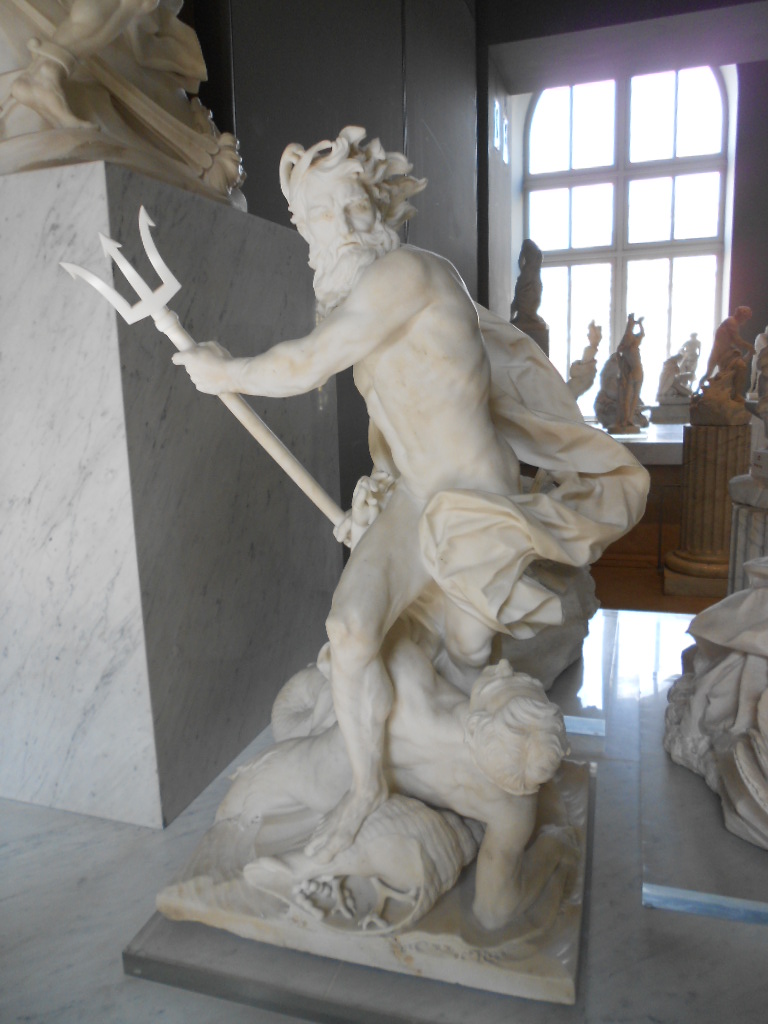
"Neptune Calming The Waves"
http://www.louvre.fr/llv/oeuvres/detail_notice.jsp?CONTENT%3C%3Ecnt_id=10134198673238934&CURRENT_LLV_NOTICE%3C%3Ecnt_id=10134198673238934&FOLDER%3C%3Efolder_id=9852723696500822&baseIndex=22&bmLocale=en
"The Death of Dido" (Cayot 1711)
Dido, the founder and queen of Carthage, has just been abandoned by her Trojan hero Aeneas, the son of Venus, gone in search of a new kingdom. In an act of lonliness and desperation, she decides to kill herself on a pyre built to burn her faithless lover's possessions. The scene is theatrical: the queen, kneeling on the pyre, eyes raised heavenward, plunges her lover's sword into her breast, thrusting the sheath behind her with her left arm. A few drops of blood flow from the wound.
Tragedy and sensuality are closely mingled here: Dido's suicidal pose, as she kneels on a soft cushion, is both elegant and revealing. Her fine tunic, open at her breast, shows the line of her thigh; the flowing cloak that has slipped from her shoulder is held in place at the hip by a finely-worked clasp, and a lock of hair emphasizes the nudity of her shoulder.
Okay... The taxi's waiting, he's blowing his horn... and we're leaving on a jet plane!
More pics from Paris to come but I will catch up from London!
Some pics I took from my I-Phone at night...
 |
| Les Halles |
 |
| Hundreds drink wine, light candles and socialize all night long beside the Seine every night till dawn... |
 |
| The Louvre at night... |
 |
| Monument between the Louvre and Champs Elysees with the Eiffel Tower in background... |